


Successful coronary surgical stenting: a new hybrid approach
ABSTRACT
Our goal is to introduce a new hybrid coronary revascularization concept—coronary surgical stenting. The procedure was performed on a 78-year old woman with severe, long and calcified involvement of the proximal left anterior descending artery, chronic total occlusion of the mid-left anterior descending artery and severe disease in the distal left anterior descending artery. An off-pump minimally invasive procedure was performed through the fifth intercostal space, including concurrent surgical placement of a drug-eluting stent in the distal left anterior descending artery, through the left anterior descending artery graft incision, associated with the left internal mammary artery to the mid-left anterior descending artery graft. This procedure resulted in successful revascularization of the left anterior descending artery in a patient with complex coronary disease.
Keywords: Coronary disease • Hybrid coronary revascularization • Coronary surgical stenting
INTRODUCTION
Our goal is to introduce a new hybrid coronary revascularization (HCR) concept—coronary surgical stenting. The mainstay of this procedure is to perform an off-pump minimally invasive proced- ure consisting of concurrent surgical placement of a drug-eluting stent (DES) in the distal left anterior descending artery (LADA), through the LADA graft incision, and associated with the left in- ternal mammary artery (LIMA) to the mid-LADA graft.
CASE REPORT
We report a 78-year old woman with a history of a myocardial in- farction with posterior ST segment elevation who underwent a primary percutaneous coronary intervention (PCI) and DES im- plantation on the second marginal obtuse artery. One year after the procedure, the patient presented with stable Canadian Cardiovascular Society 2 typical chest pain. An echocardiogram revealed preserved ejection fraction and no wall motion abnor- malities. SPECT showed extensive anterior ischaemia. The patient was examined with coronary angiography, which revealed a se- verely calcified long proximal LADA with 70–90% stenosis and chronic total occlusion (CTO) of the mid-LADA. The distal LADA was filled through the right coronary artery (RCA) and had a long 90–99% stenosis (Fig. 1A and B). The RCA was non-dominant and presented with proximal severe lesions; LADA filling was done by an epicardial collateral. The patient had severe proximal LADA involvement, a Syntax Score of 30.5 and an EuroSCORE II mortality risk of 2.86%.
Anterograde or retrograde PCI was considered technically chal- lenging, and the LIMA-to-LADA anastomosis would be too distal due to mid-CTO of the LADA CTO and a distal lesion.
An off-pump minimally invasive HCR procedure was performed under general anaesthesia in our hybrid intervention room. The right femoral artery was punctured and a 6F introducer sheet was inserted. A JR4® diagnostic catheter was placed in the ‘ostium’ of the RCA. The distal LADA was filled through a contrast injection in the RCA.
A small left thoracotomy was performed at the fifth intercostal space, and the LIMA was prepared for single CABG. An Octopus®4 was used to stabilize the LADA. An incision in the mid- to distal LADA was performed. The following technique was carried out under fluoroscopic guidance and contrast injection in the RCA:
(i) A Hi-Torque Balance Middleweight Universal® Guide Wire was advanced through the LADA incision; (ii)A predilatation balloon (Tazuna®, 1.5×15mm) was intro- duced over the wire and the distal LADA lesion was dilated; (iii) A DES (Synergy®, 2.25 × 38 mm) was further advanced over the wire and was implanted at the distal lesion with an optimal angiographic result and TIMI III flow (Fig. 2A and B; Video 1); (iv) The guide wire was removed and a LIMA-to-LADA anastomosis was performed through the previously described incision.
After surgical stenting, the JR4® diagnostic catheter was placed in the LIMA ostium, and angiographic images were taken. The images revealed that the distal anastomosis was performed over a severe atherosclerotic lesion (Fig. 2C). The JR4® diagnostic catheter was replaced by a LIMA guide catheter, a Hi-Torque Balance
J.G. Poveda et al. / Interactive CardioVascular and Thoracic Surgery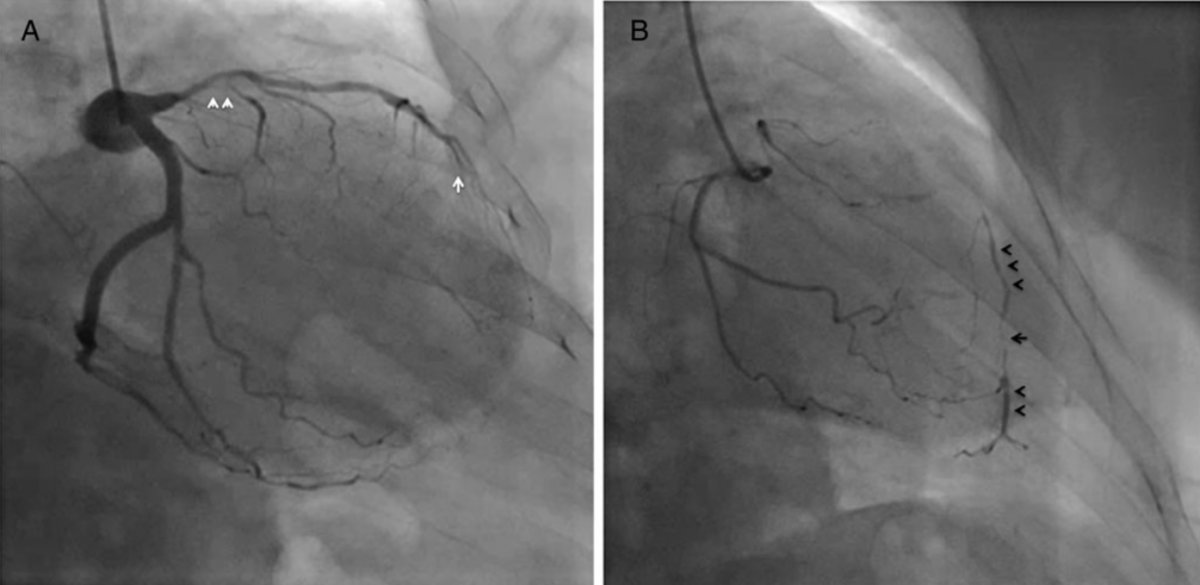
Figure 1: Coronary angiogram: (A) Left coronary RAO caudal projection revealing the described proximal-LAD lesion (white arrow heads) and mid-LAD CTO (white arrows); (B) Right coronary RAO simple projection showing severe proximal-RCA disease, LAD distal filling (black arrow heads) through an epicardial collateral and a distal long 90-99% LAD stenosis (black arrow) after the mid CTO. CTO: chronic total occlusion; LAD: left anterior descending artery; RAO: Right anterior oblique; RCA: right coronary artery.
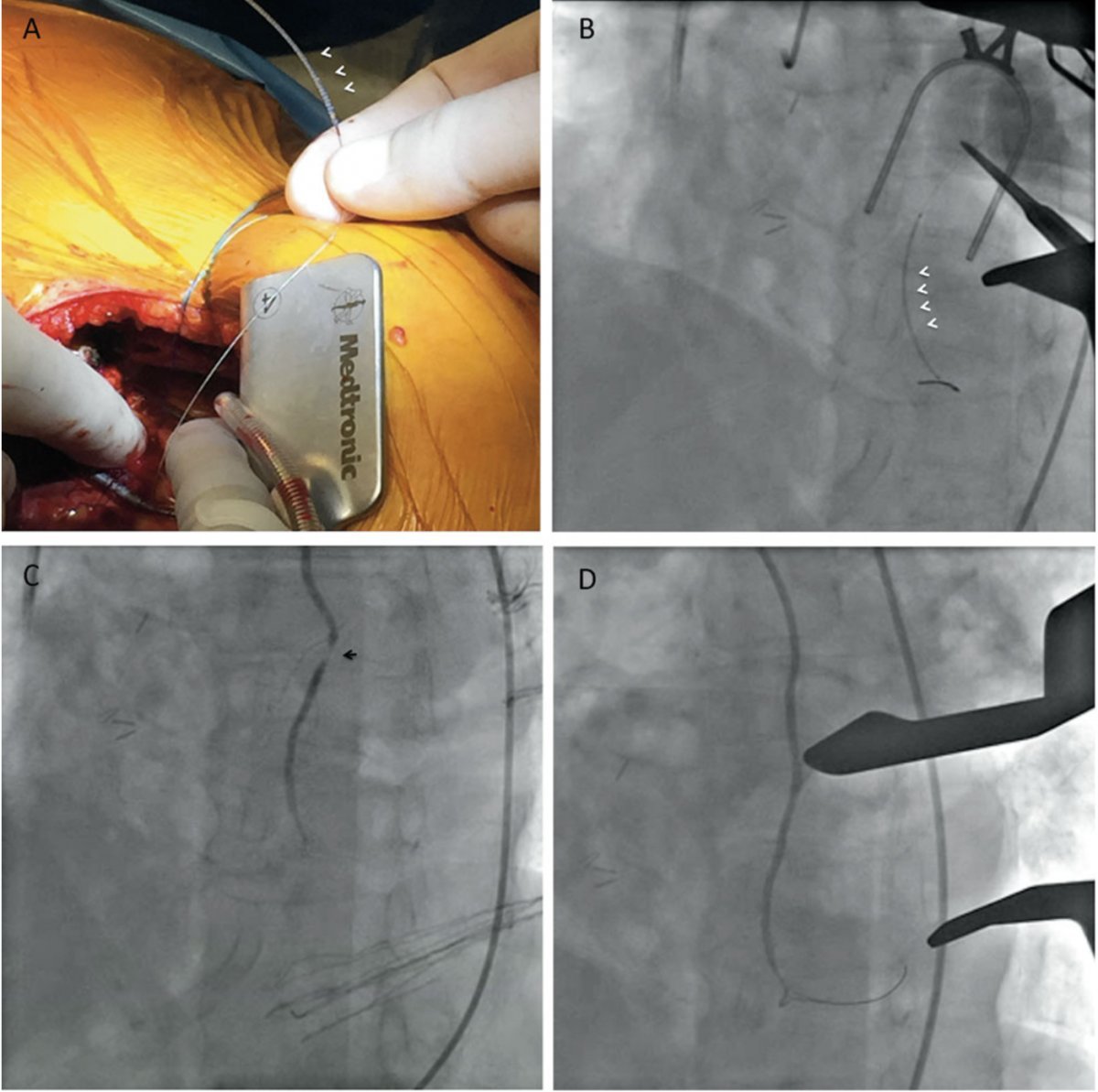
Figure 2: Coronary surgical stenting procedure: (A and B) DES advanced over the wire through the mid LAD incision and implanted at the distal lesion (white arrow heads); (C) Distal anastomosis lesion (black arrow head); (D) Final angiographic result with TIMI III flow. DES: drug-eluting stent; LAD: left anterior descending artery.
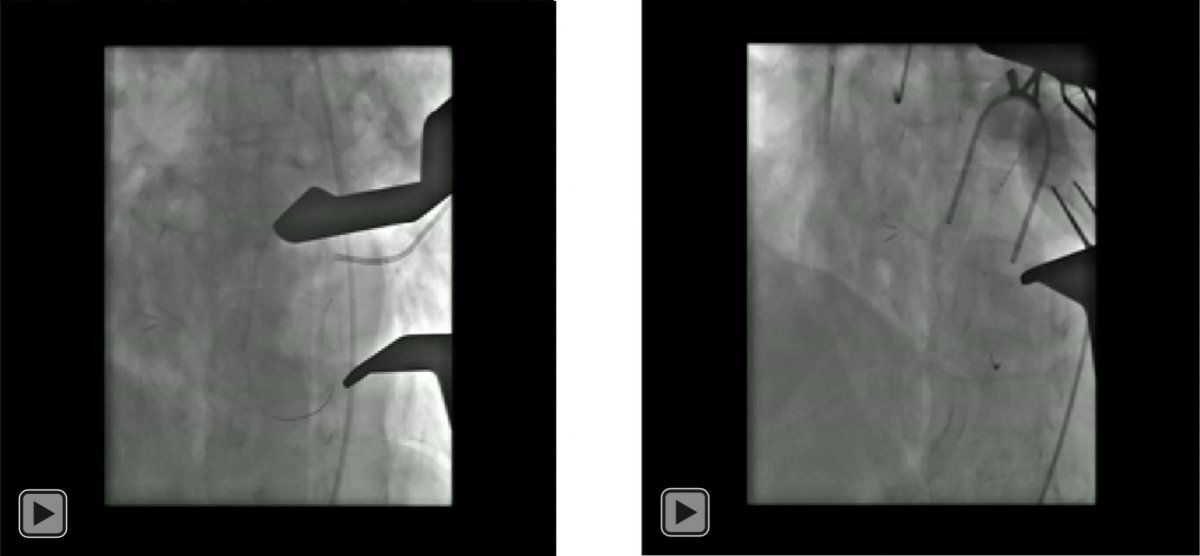
Video 1: Coronary surgical stenting procedure.. Video 2: Coronary surgical stenting procedure—final angiographic result.
Middleweight Universal® Guide Wire was advanced to the distal LADA through the LIMA graft and an intraoperative PCI of the anastomosis was performed using a DES (Synergy®, 2.50×12 mm). The angiographic result was excellent with TIMI III flow (Fig. 2D; Video 2). The patient was discharged after 72 h and was angina free at the 3-month follow-up visit. To the best of our knowledge, this is the first report of an off-pump minimally invasive coronary surgical stenting procedure through the LADA graft incision, associated with a LIMA-to-mid- LADA graft and complemented with an intraoperative LIMA-to- LADA anastomosis.
DISCUSSION
Unless the overall experience, outcomes and financial implications of HCR are significantly better than those for standard CABG alone in the long term, HCR will continue to play a limited role in coronary revascularization [1, 2].
However, new innovative techniques are needed to achieve complete revascularization. Coronary surgical stenting is a new innovative HCR technique developed in our centre that allowed full LADA revascularization in this patient. The ideal subset of patients for whom this minimally invasive HCR procedure is acceptable is still to be determined. In the future, with continuing technical and technological advancement, this technique may be widely used.
Conflict of interest: none declared.
REFERENCES
[1] Halkos ME, Ford L, Peterson D, Bluestein SM, Liberman HA, Kilgo P et al. The impact of hybrid coronary revascularization on hospital costs and reim- bursements. Ann Thorac Surg 2014;97:1610–5. [2] Harskamp RE, Bagai A, Halkos ME, Rao SV, Bachinsky WB, Patel MR et al. Clinical outcomes after hybrid coronary revascularization versus coronary artery bypass surgery: a meta-analysis of 1190 patients. Am Heart J 2014; 167:585–9.