UmiCS
Robotic Cardiac Surgery
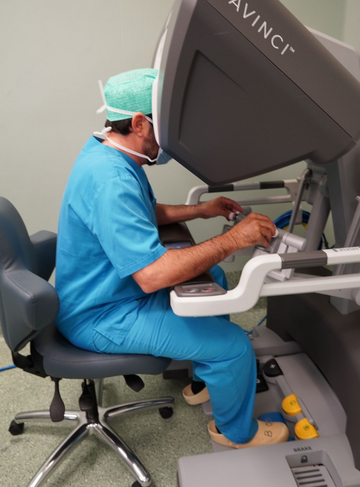
Robotic Cardiac Surgery is a minimally invasive technique that uses a surgical robot controlled by a surgeon to perform complex cardiac procedures.
Book an Appointment
For any clarification, you can contact our Customer Service at 911 501 808.

WHAT IS PERCUTANEOUS ATRIAL FIBRILLATION TREATMENT?
Cardiac ablation is performed in hemodynamics centers, where there is advanced imaging equipment and other equipment that allows blood pressure, temperature and heartbeat to be monitored.
Description of the procedure
First, an electrophysiological study will be carried out to map the points that produce irregular electrical impulses. At this stage, a catheter will be inserted into your body via a puncture, which can be made in the femoral artery. In some cases, it can be accessed through the arm, chest or neck. The doctor will guide this catheter to the left atrium to identify the points.
After mapping, ablation is performed. The catheter will be replaced by another with a small device that emits pulses or intense cold to isolate or cauterize the tissues and vessels responsible for the arrhythmia. Generally, the pulmonary veins are isolated.
The patient may be hospitalized for 24 hours. Before they are discharged, they will receive a series of instructions detailing the care they should observe in the post-intervention period, which is usually seven days. After this period, they can continue with their daily routine.
The duration of percutaneous atrial fibrillation treatment is usually 100 minutes. Patients are discharged after 1-2 days.
As far as work activity is concerned, after 7 days the patient can return to work. Full mobility is usually restored after 1 week and moderate physical activity after 2 weeks.
Duration
> 100 min
Anesthesia
> sedation
Hospitalization
> 1 day
Medical leave
> 1 week
Recovery
> 1 week
Inhibition of physical activity
> 2 weeks
Learn more
about this
procedure
Make an appointment to clarify any doubts or call us through our contacts